
Indigenous Engagement at POLSIS
With over 400 million Indigenous people worldwide and Indigenous politics featuring as a prominent and crucial debate in the Australian polity, the School is committed to increasing its engagement with Indigenous peoples and knowledges, contributing to decolonisation and richer expressions of our disciplines. This includes
- Learning about Indigenous affairs: as staff and employees, as teachers and students, and as researchers.
- Organising events: Research seminars, workshops, curated talks, lectures, exhibitions and showcases.
- Researching and publishing, including cooperatively: Books, research articles, journalism and public communications, reports.
The School’s work in and contributions to Indigenous Engagement complement UQ’s commitment to reconciliation through the different stages of its Reconciliation Action Plan (RAP).
POLSIS Indigenous Engagement Highlights:
1. Indigenous Mentorship

Lyndon Murphy is the School’s Senior Indigenous Mentor. A Jinibara man with extensive experience in Indigenous Affairs and higher education, Lyndon guides the School’s engagement efforts. He supports School staff to build capacity in Indigenising the curriculum; provides mentorship to indigenous and non-indigenous students; develops students’ knowledge of indigenous political issues; and builds and strengthens relationships with indigenous colleagues through local, national and international networks.
2. Learning at POLSIS: Indigenous Politics Courses (undergraduate & postgraduate)
POLS1801: Introduction to Indigenous Issues 
This course introduces students to relations between dominant political systems and Indigenous peoples, including entanglements between dominant and Indigenous approaches to political order, law, policy, rights, knowledge, governance, community, conflict and diplomacy. The course emphasises interactive learning and creative analysis to introduce understandings and skills to work across difference. POLS1801 is the first course of its kind nationally, using Indigenous pedagogical approaches to engage political relations. It offers a strong grounding for POLS2101.
POLS2101: Indigenous Politics & Policy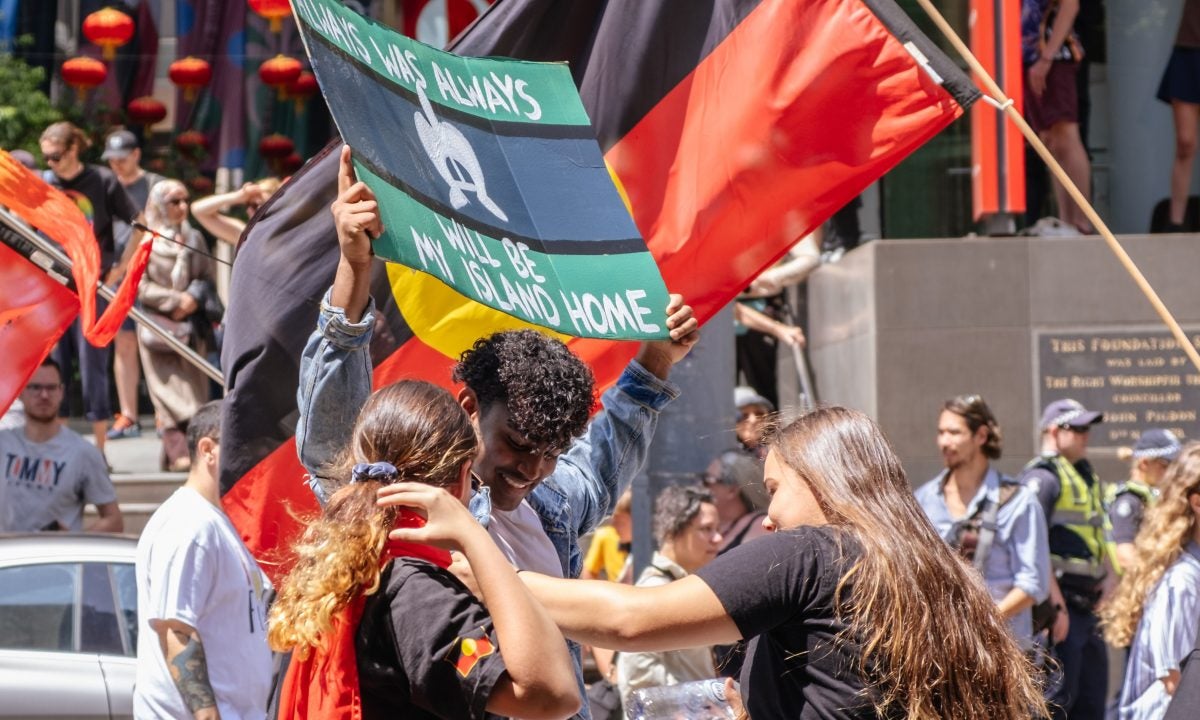
This course traces the political relationship between Indigenous and non-indigenous peoples of Australia as an instance of wider global relations among Indigenous societies, colonial powers and contemporary national and international regimes and institutions. The course considers - among other topics - land, citizenship and identity, self-determination, constitutional recognition, and the governance of Indigenous organisations. POLS2101 asks critical questions about the way knowledge is structured and operates, opening students to alternative ways to think about politics and political relations.
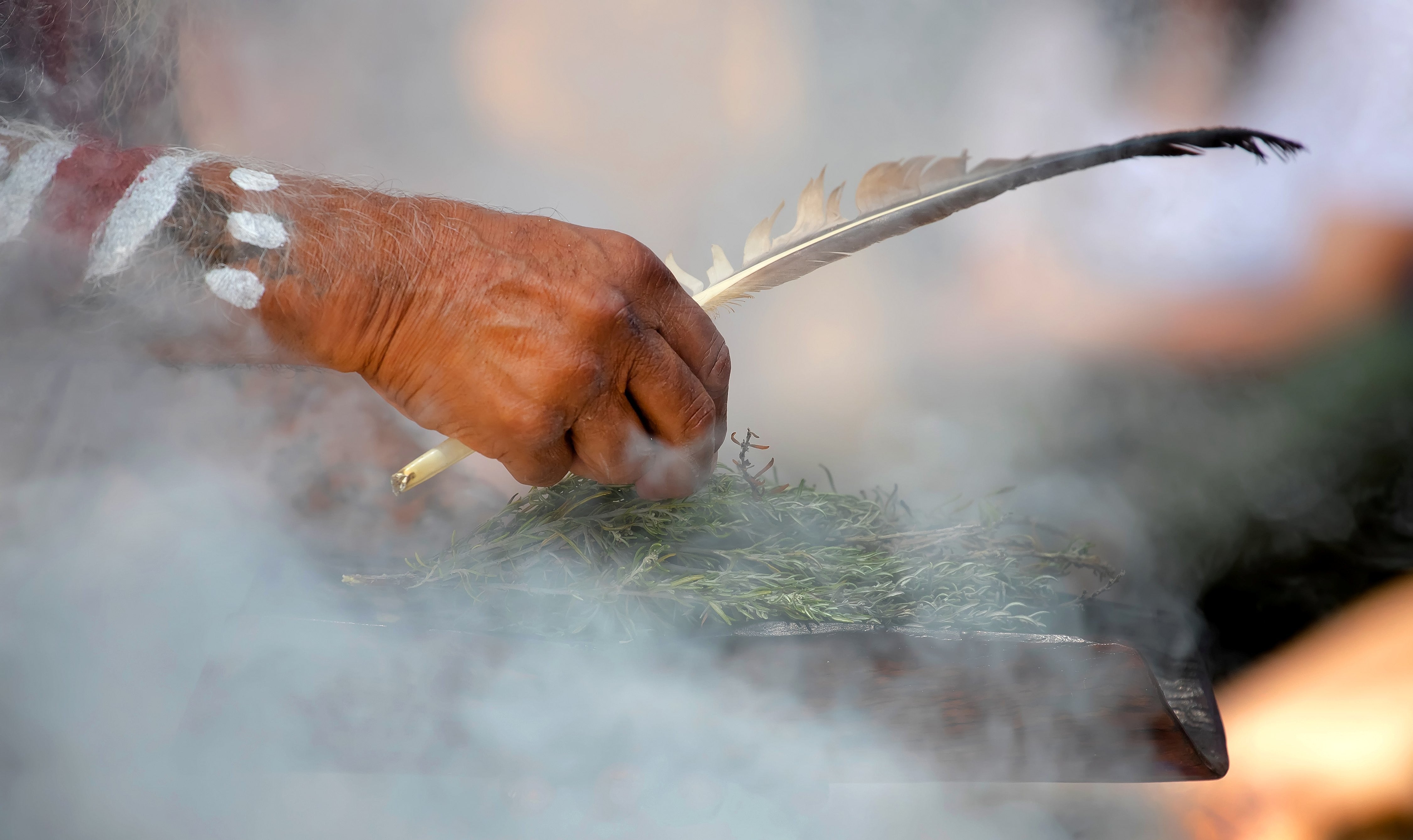
POLS7190: Indigenous Politics within and Beyond the State
This course examines the relationship between Indigenous and dominant conceptions of (international) politics. These themes are examined in the context of the development of transnational Indigenous activism in the late 20th Century and the challenges of ongoing conflicts between Indigenous peoples and settlers in settler-colonial societies. The course increases understanding of Indigenous peoples, advances creative thinking about alternative ways of constituting and maintaining political order, and enhances capacities for working across cultural difference.
3. Publications and Broader Outreach
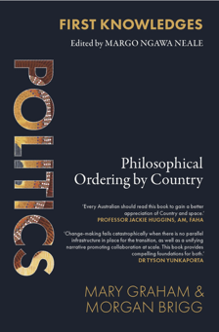
Aboriginal peoples of Australia have engaged in socio-political ordering for tens of thousands of years. Engagements with their political concepts, ideologies and peoples should be a high priority for political science. Honorary Prof Mary Graham (Kombumerri and Waka Waka) and Prof Morgan Brigg help readers to start thinking about this. Take a look at their series of essays published on the ABC’s Religion & Ethics Website, or their recently published book "Politics: Philosophical Ordering by Country".
4. Around POLSIS Corridors
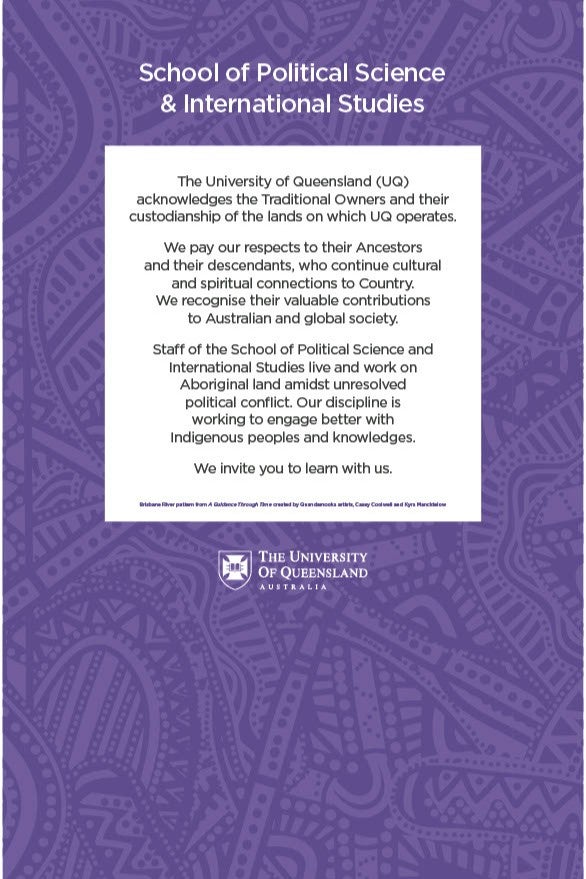
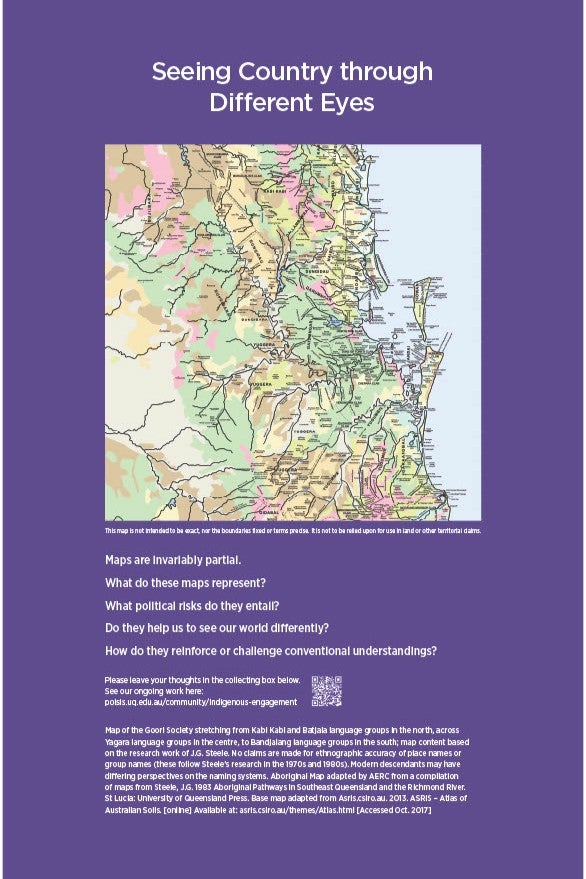
The Triptych (General Purpose North Building 39A, Level 5, POLSIS)
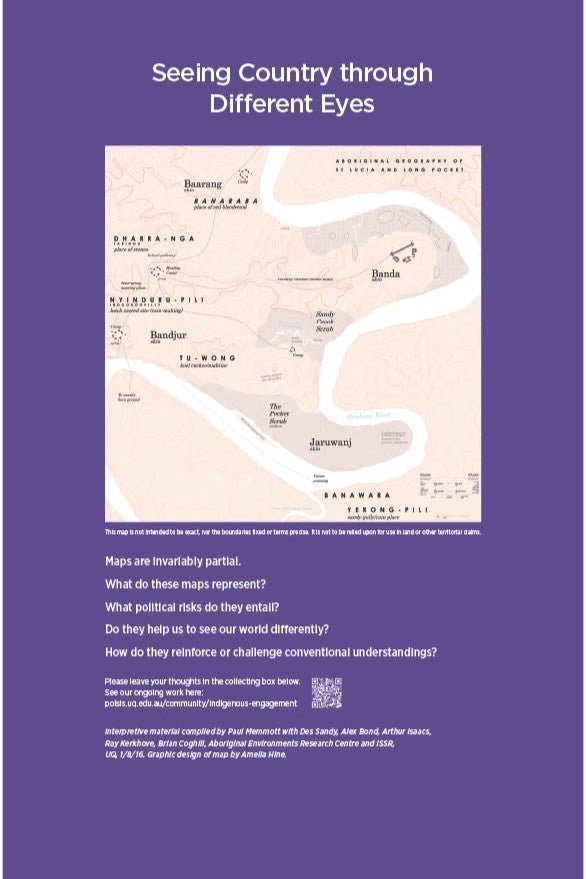
This display comprises two maps, one depicting the Aboriginal cultural geography of the area known today as St Lucia and Long Pocket, the other the wider lands surrounding this area.
Maps are always partial, highlighting particular aspects and bypassing others. The Triptych challenges us to reflect on our practices of viewing and using maps, especially also with regard to their political implications.
 |  |  |
Artwork on Display

"Fiona Foley is an artist from the Wondunna clan of the Badtjala nation, the traditional owners of K'gari,
whose art has been widely exhibited across Australia and internationally.
Opium series (2008) is a series that explores the colonial-era exploitation of Aboriginal people in
Queensland. The series specifically critiques the Aboriginals Protection and Restriction of the Sale of
Opium Act 1897, which was used to control and displace Indigenous communities.
This Act established long-term government control over Aboriginal affairs.
It introduced reserves and strict regulation of Aboriginal people both on reserves and in wider society.
The legislation combined concerns about relations between settlers and Aboriginal communities with
anxieties about Chinese communities and opium use."
Text from a reflection on Fiona Foley's Opium #5-Labour by POLSIS colleague Dr Sarah Ball (Governance and Public Policy)
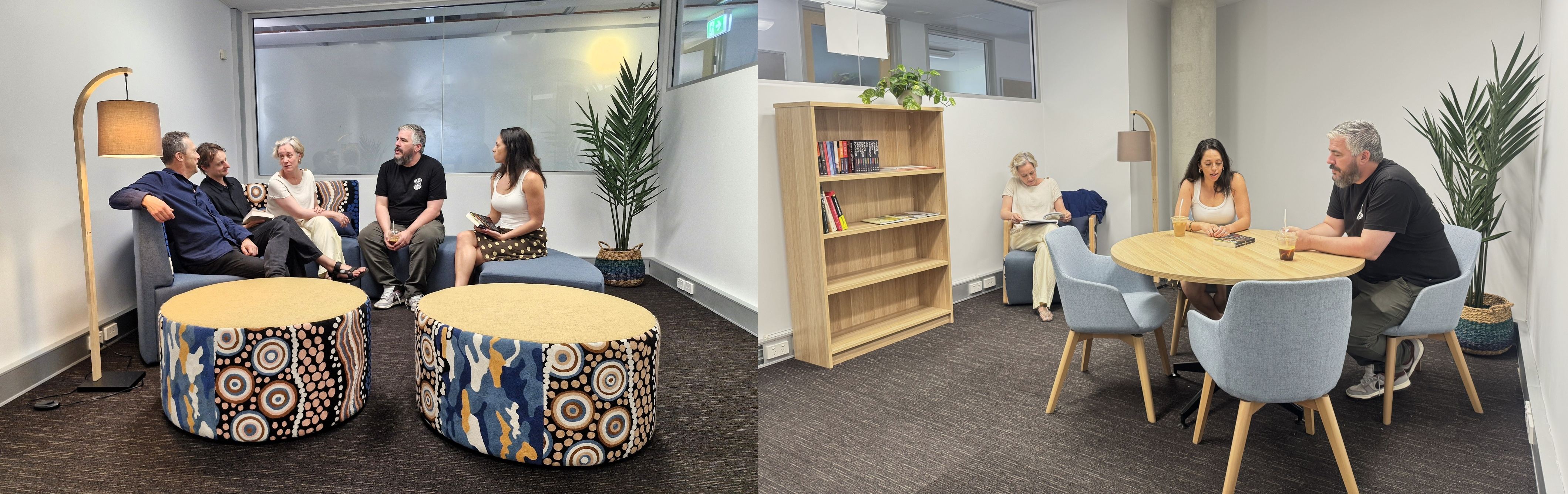
Common Room 517 (Level 5, General Purpose North Building 39A, POLSIS)
The room’s design tells the story of place, protection, and ongoing connection - centring the understanding that the UQ campus sits on a peninsula embraced by the Brisbane River, known as Kabul (Carpet Snake), which holds and nurtures the land and its people.
Adjunct Professor Dr Mary Graham contributes to a series of discussions on “How the Country was Run”, focusing on Aboriginal conceptions of governance and socio-political order, and how these interact with European counterparts under the conditions of settler-colonialism.

Publications
A number of academics in the School actively publish on Indigenous politics in a range of outlets. Selected publications include:
Graham, M., & Brigg, M. (2024). Indigenous diplomacy for an Australian civilisational ethos? - Australian Institute of International Affairs. Australian Institute of International Affairs.
Hutchison, E., Bleiker, R., Bourne, J., & Hoang, Y. (2024). Decolonising affect: Emotions and the politics of peace. Cooperation and Conflict.
Benson, E., Brigg, M., Hu, K., Maddison, S., Makras, A., Moodie, N., & Strakosch, E. (2023). Mapping the spatial politics of Australian settler colonialism. Political Geography, 102, 102855.
Brigg, M., & Graham, M. (2023). Approaching First Nations diplomacy from the Australian continent. Australian Journal of International Affairs, 77(6), 585–589.
Brigg, M., & Graham, M. (2023). Holding contradictions: toward the lawful carriage of Indigenous diplomacy. Australian Journal of International Affairs, 77(6), 682–692.
Graham, M., & Brigg, M. (2023). Indigenous international relations: old peoples and new pragmatism. Australian Journal of International Affairs, 77(6), 590–599.
Graham, M., & Brigg, M. (2023). Indigenous Public Policy Futures: A manifesto for Relationalist Public Administration. In Moodie, N., Maddison, S. (eds) Public Policy and Indigenous Futures. Indigenous-Settler Relations in Australia and the World, vol 4. Springer, Singapore.
Phillips, A. (2023). Indigenous foreign policy: the challenges of survivalism before and after the era of Western dominance. Australian Journal of International Affairs, 77(6), 637–643.
Weber, M. (2023). Can International Relations (IR) learn? The politics of ‘doing understanding’. Australian Journal of International Affairs, 77(6), 664–669.
Brigg, M., & Walker, P. O. (2022). Indigenous approaches to peace. In Richmond, O.P., Visoka, G. (eds) The Palgrave Encyclopedia of Peace and Conflict Studies. Palgrave Macmillan
Brigg, M., George, N., & Higgins, K. (2022). Making space for Indigenous approaches in the Southwest Pacific? The Spatial Politics of Peace Scholarship and practice. Journal of Intervention and Statebuilding, 16(5), 545–562.
Brown, P.R., Bourne, J., & Brigg, M. (2022). Governance and Indigenous-State Entanglement. Australian Political Science Association (APSA) Annual Conference, Australian National University, ACT, Australia, 26-28 September 2022. Canberra, ACT, Australia.
Fredericks, B., Martin, K., Warner, B., Perkins, R., Combo, T., McConochie, E., Stajic, J., Thomson, A., Holland, L., Olssen, E., Thompson, K., Broderick, T., Gilbert, S., Murphy, L., Lee, N., Beetson, S., Fraser, J., Allan, H., & Bunda, T. (2022). Ready to write. Journal of Australian Indigenous Issues, 25(3–4), 1–10.
Brigg, M., & Murphy, L. (2021). Beyond ‘Structured Inattention’: Towards Australian Indigenous Political Studies? In The Oxford Handbook of Australian Politics (pp. 545–559). Oxford University Press.
Brigg, M., Graham, M., & Weber, M. (2021). Relational Indigenous systems: Aboriginal Australian political ordering and reconfiguring IR. Review of International Studies, 48(5), 891–909.
Brown, P. R., & Warner, S. A. (2021). Is Indigeneity hidden in the shadow of Australian national school reforms? Australian Journal of Social Issues, 57(2), 314–328.
Brigg, M. (2019). Registers of relationality for knowing Indigenous-Settler politics. In Indigenous-settler relations in Australia and the world (pp. 15–31).
Brigg, M., Graham, M., & Murphy, L. (2019). Toward the dialogical study of politics: hunting at the fringes of Australian political science. Australian Journal of Political Science, 54(3), 423–437.
Brown, P. R. (2019). Understanding barriers to new approaches – a case study from Australian remote indigenous policy. Critical Policy Studies, 14(4), 408–425.
Brown, P. R. (2017). Attempting to cultivate mindsets for boundary spanning in remote Indigenous policy. Australian Journal of Public Administration, 76(4), 412–425.
Brigg, M. (2016). Engaging Indigenous Knowledges: From Sovereign to Relational Knowers. The Australian Journal of Indigenous Education, 45(2), 152–158.
Brigg, M. (2016). Identity and politics in settler-colonialism: relational analyses beyond domination? Postcolonial Studies, 19(3), 342–350.
Brigg, M., & Murphy, L. (2016). Noel Pearson’s Hunt for the “Radical Centre” is Doomed. The Age.
Strakosch, E. (2015). ‘Settler Fantasies’. In F. Nicoll and L. Martin-Chew (eds.). Courting Blakness: Recalibrating Knowledge in the Sandstone University. Brisbane: UQ Press.
Strakosch, E. (2015). Neoliberal Indigenous policy. In Palgrave Macmillan UK eBooks.